
Stoicism and Becoming a First Time Father
This essay was submitted as part of the Marcus Aurelius Program | College of Stoic Philosophers.
Don’t explain your philosophy, embody it. Part of what drew me to Stoic Philosophy was the fact that it was not just an intellectual exercise, but rather a practical guide to develop good character. The theoretical element of Stoicism is not about proving to others your knowledge, but the actions produced by this theory after it has been digested (Epictetus, Enchiridion 46). This essay explores how Stoic Philosophy came at the right time for me. I believe that it is due to my study and practice that I have become a better father and husband than would have otherwise been the case. It's important to note that I said better, and not best. I still have a lot of work to do to become a better version of myself each day, and I see this pathway being paved through the practice of Stoicism.
Focusing on What Is Up to Us, What We Control
Epictetus teaches us arguably one of the most fundamental teachings in Stoic Philosophy. Some things are in our control and others not (Epictetus, Enchiridion 1). Often referred to, somewhat controversially, as the dichotomy of control, it encourages us to distinguish what is up to us and what is not up to us. This teaching became crucial during our journey into parenthood.
Like many couples, we experienced miscarriages on our journey to becoming parents. This topic is still at times taboo, but we decided to be open about our journey, hoping to make it easier for others to share theirs, particularly when they are finding it tough. It was on the third positive pregnancy test that we made it through the 12-week milestone, and we were fortunate to welcome Thomas, a healthy boy into the world on Christmas Eve 2024.
The experiences of miscarriage tested our resilience and perspective. Through those difficult times, Stoicism provided me with a practical framework for processing grief and accepting what is not up to us. Previously, I would have been angry with the world and looking for somebody else to blame. I would have leaned into the victimhood mentality. But the teaching of Stoicism has taught me an important lesson, how much more damage anger and grief do than the things that cause them (Marcus Aurelius, Meditations 11.18). What is up to us is not the biological process or the outcome, but in how we respond to any situation that presents itself.
When Thomas finally arrived, this principle continued to serve me well. As many before us know, newborns don't follow schedules or respond to reasoning. By focusing on what is up to me: my ability to be patient (which has historically been low, but has improved!), my eagerness to learn, my presence in moments both joyful and challenging, I found myself better equipped to handle the inevitable surprises of parenthood.
We Are Social Creatures
In his Meditations, Marcus Aurelius teaches us that we are all fundamentally interconnected through sympatheia, a universal connection that binds us all together. Marcus emphasises that human flourishing depends on our relationships and duty to others. He reminds us that we were born to work together like feet, hands, and eyes, like the two rows of teeth, upper and lower (Marcus Aurelius, Meditations 2.1).
This understanding of our social nature proved to be so important during our journey into parenthood. The familiar saying "It takes a village" when discussing raising a child resonated with me deeply, not only during Thomas's first few months, but also throughout the pregnancy and our earlier miscarriages. Stoicism teaches us that we are all small parts of the greater whole, and we have a duty to look out for our fellow humans.
The support shown to us throughout this journey proved invaluable: comfort during difficult times, love shown to Thomas and us during those first few delicate weeks, thoughtful gifts, and meals delivered to our door.
As we journey through life, we acquire new roles: father, husband, grandfather, uncle. Our kathêkon, our appropriate action, is to fulfil these roles as excellently as we can. Epictetus teaches us to act well in our given parts (Epictetus, Enchiridion 17). Throughout this experience to becoming parents, we witnessed the best of human nature as friends and family embodied their own roles as supporters.
We have been privileged to watch close friends give birth during these recent months and have endeavoured to fulfil our role in their support networks, recognising that our duty to the common good extends beyond our immediate family circle.
Placing Value in Externals
Stoicism divides all things into three categories: good (virtue), bad (vice) and everything else (external indifferents). Within external indifferents, it then distinguishes between preferred indifferents such as health, wealth, good reputation, and dispreferred ones like illness, poverty, bad reputation. And while we're taught that it is reasonable to pursue indifferents, we should not do so at the cost of living virtuously, and we must not mistake indifferents for genuine goods and allow them to determine our happiness. Marcus Aurelius in his Meditations teaches us that external things are not the problem. It's our assessment of them which we can erase right now (Marcus Aurelius, Meditations 8.47). This key Stoic teaching became increasingly relevant as fatherhood approached.
As we mature, it becomes easy to get caught up in placing ultimate value in external indifferents. Society instils this through clever marketing and psychological persuasion, whether through physical externals like cars and clothing, or through our activities and interests, defining ourselves as runners, paddlers, or sailors.
Even before Thomas was born, I had begun moving away from placing my sense of worth in externals beyond my control. However, I often still allowed my routine of activities and interests to define me, becoming upset when this routine was disturbed. This remains a work in progress, though Thomas's presence has highlighted it even further. I want to teach him from a young age that the value of our character, our disciplines of desire, action, and judgement, is where true worth lies. Living virtuously is the only inherent good and everything else can be beneficial or harmful depending on how we use it. Virtue allows us to use external indifferents well.
I want to teach Thomas that pursuing externals remains acceptable provided we don't seek happiness through them. True eudaimonia comes from living according to our rational nature, not from external achievements or possessions.
This lesson extends to those we love most, even our loved ones are externals. Epictetus delivers one of the harder lessons to accept in Stoic Philosophy that we must love with reserve as it is inevitable that those closest to us can be lost in an instant (Epictetus, Enchiridion 3). This lesson in isolation can sound quite harsh, but when explored more deeply it allows us to truly cherish the time we have together.
Living According to Virtue
In Seneca's Moral Letters to Lucilius, he teaches us that Virtue is a man's unique good. That reason (virtue) alone brings man to perfection, and reason alone, when perfected, makes man happy (Seneca, Letter 76). Unlike external indifferents, virtue cannot be taken away from us, and anyone can live a virtuous life, regardless of their circumstance. As a father, I've become acutely aware of my role as a model for Thomas, and I want to teach him this lesson. That what is most important is to always act with right reason. It will take time and experience, as well as making mistakes. However, knowing that you can always lean into the cardinal virtues when times are tough and important decisions need to be made, this will be a guide to get you through.
To act with courage. Not in the sense of physical bravery, but to have the strength to do what is right despite potential negative consequences. This will mean being able to have difficult conversations, making unpopular decisions or standing firm on moral principles. In raising Thomas this will mean setting boundaries, owning my own mistakes and modelling integrity in every situation.
To act with justice, to individuals no matter their circumstance and to our broader society. As Thomas's father this means treating him with fairness while ensuring he is considering the welfare of others in his actions.
To act with moderation. Finding balance and avoiding excess. To find happiness with the simple things in life that nature provides us. To develop self-discipline in managing our desires and impulses.
To act with wisdom. To make sound judgements and decisions in a logical and considered way, rather than acting with passion or impulse. Wisdom provides me with the knowledge to consider my actions and my words carefully as I become a role model to Thomas over the years.
It Is Not the Situation That Upsets Us, But Our Judgement of That Situation
Men are disturbed, not by things, but by the principles and notions which they form concerning things (Epictetus, Enchiridion 5). This ancient Stoic principle has been incredibly helpful throughout my journey into parenthood, extending beyond the earlier challenges I've discussed. Once Thomas arrived, those early moments of having an upset baby in which nothing can soothe them, to disrupted nights of feeding and nappy changes, it is all too easy to experience inadequate impressions in these moments, to make false judgements of the situation you're confronted with and be upset by this. Or you can accept the situation for what it is: a newborn who is working their way through those early days, faced by a new father whose job it is to be there for both baby and partner, to play your role well.
Seneca reminds us that we must make the most of our time. It is not that we have so little time but that we lose so much when we use it wastefully (Seneca, On the Shortness of Life 1). Becoming a father teaches you that the free time you used to enjoy is immediately taken up with the responsibilities of being a father and supportive partner. I knew from the day we began our journey to starting a family that I wanted to be a present father. When the time that used to be spent on other hobbies or being able to make last minute decisions to go out for a meal or catch a game gets taken away from you, it could be easy to get upset by this predicament and begin to feel resentful to somebody taking this away. But when we reframe the situation to being able to experience the joy of being a father and being thankful that I am in a situation that allows me to be present as a father, it allows me to view this time with another lens, and be grateful for the situation I find myself in.
Oikeiosis: From Self-Preservation to Universal Concern
The Stoics proposed that humans are naturally programmed by what they called oikeiôsis, 'affinity', both for behaving in ways that promote preferred indifferents such as our own health, wealth, or reputation, and for acquiring the virtues required to do that appropriately; and to identify with the interests of one's parents, friends, and country and acquiring rationality and right reason to achieve this (Brad Inwood, Cambridge Companion to the Stoics).
This teaching is one of Stoicism's most important lessons about our journey into becoming a rational human being. Oikeiosis describes the natural process by which we expand our circle of concern from immediate self-interest to encompass family, community, and eventually all of humanity. Oikeiosis was illustrated by Hierocles, where he outlined concentric circles, with the self at the centre and our moral task in developing rationality being to draw those circles toward the centre.
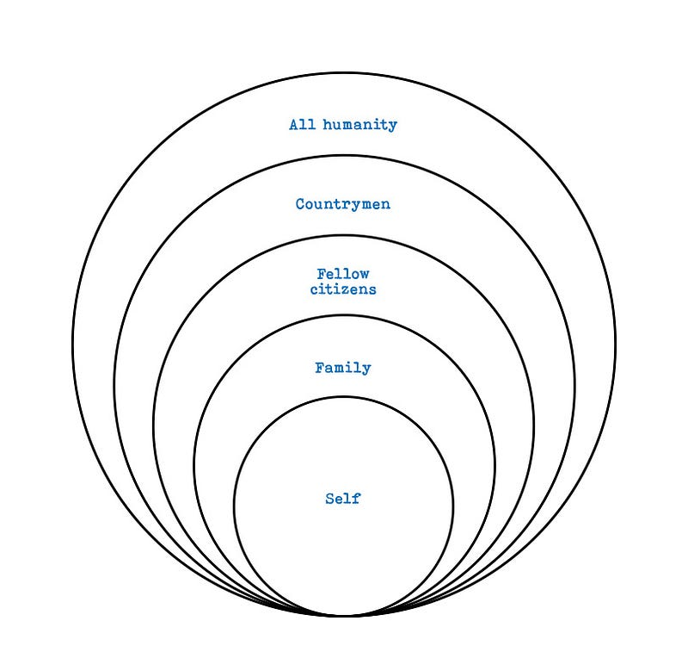
Hierocles' "circles of concern model illustrating expanding circles of human relationships
Becoming a father has provided me with direct experience of how oikeiosis operates in practice. The arrival of Thomas immediately expanded my circle of primary concern. Thomas's presence also draws our extended family and community closer to our centre, creating networks of care and support that extend beyond our immediate household. It also provides motivation to work toward leaving a better world for Thomas and his generation.
Oikeiosis provides a different perspective to understand Thomas's own developmental journey. Currently, I observe how he operates in what the Stoics would recognise as the fundamental stage of self-preservation, his primary concerns being food, comfort, and safety. This is not selfishness but the natural starting point for all rational development. My role as his father becomes part of guiding this journey, helping him recognise his connection to family, then to community, and eventually to humanity.
Watching Thomas begin this journey whilst continuing my own provides daily reminders of both how far we can grow and how much work remains in expanding our circles of moral concern.
Conclusion
As I opened this essay in recognising that Stoicism serves as a practical guide for developing good character, my journey into fatherhood has proven this understanding to be correct. The Stoic teachings explored have provided me with, not just theoretical knowledge, but a practice and structure that helps me to navigate the new experiences and challenges of being a father.
The Stoics were clear in their position that we never do reach sage hood and achieve ultimate virtue. For as Prokoptons we are always progressing but never arriving at complete mastery. I believe this can be applied to the journey as a father, that I will focus my energy on learning and growing, striving to improve every day, and accepting that I will never be the perfect father. I will make mistakes and emerge a better father on the other side.
I want to use the lessons that Stoicism has taught me to be a role model to help guide Thomas. Not to try and shape him into a man I want him to be, but rather to help him on his own journey to become the best version of himself. I sincerely believe that the ancient teachings of Stoicism provide a sound framework and guide to help both Thomas and me on this journey we are on together.